
01
The geography of a day out of Skardu
Four directions, four completely different days
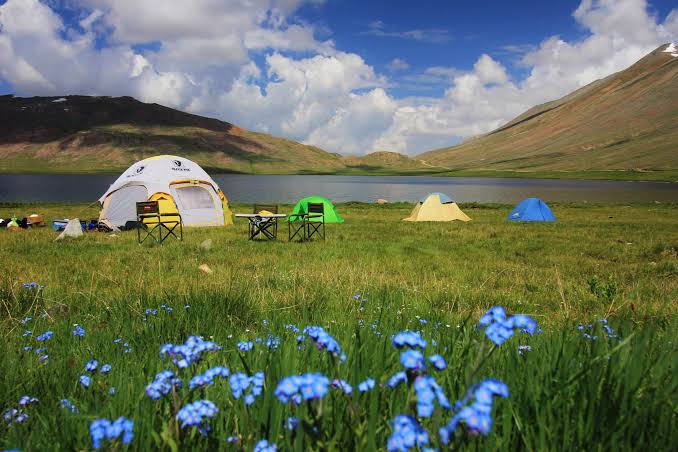
Skardu sits in a wide bowl at 2,230 metres where the Shigar river meets the Indus, and the trips out of it run in four directions. South and up is the Sadpara road, climbing past Satpara Lake onto the Deosai plateau at around 4,000 metres — the longest and highest day, and the only one that is genuinely season-locked. West along the Indus is Kachura, where the two lakes sit half an hour from town and make an easy half day. North-east is Shigar, an hour of valley floor with the fort at the end, continuing to Khaplu if you have a full day. And ten minutes from our front door, in the middle of the valley, are the cold desert dunes at Katpana, with the larger Sarfaranga spread further out toward Shigar. If you would rather see the whole week laid out in order than pick guides one at a time, the seven-day Skardu itinerary sequences all of it — flat days first, Deosai in the middle, Khaplu as its own block. North-east beyond Shigar the valley narrows to Dassu and the Braldu gorge, which is not a day trip at all but the road to Askole and the K2 Base Camp trek out of Skardu.
The mistake visitors make is treating these as interchangeable items on a list. They are not the same kind of day. Deosai costs you the whole day, a 4x4 and roughly 1,800 metres of climb. Kachura costs a morning. Shigar Fort costs an hour of flat metalled road each way and rewards a whole morning once you are there. The dunes cost an hour at the right hour and nothing at the wrong one, because midday flattens them completely and dawn or the last light before sunset is when they are worth the trip.
East of Skardu the Shyok opens toward Ghanche, and Khaplu Palace, the 1840 royal residence at Yabgo Khar, is the one destination in this set that wants a night rather than a day.
02
Season-locked versus year-round
What is actually open when you arrive
“Check the week you travel, not the month you book.”
Deosai is the only trip on this list that closes. Snow shuts the plateau through winter and it usually becomes passable somewhere between late May and late June, staying open until the first serious snow in late September or October. Nobody can give you a date in advance, and any site that publishes one is guessing. Check the week you travel, not the month you book.
Kachura, the cold deserts, Shigar and the bazaar are year-round. What changes is not access but character: the lakes are ringed with blossom in April, deep green in July and glass-still in October, and the deserts are at their strangest in winter when snow lies on the dunes, which is the image that made Katpana famous in the first place.
Road conditions are a separate question from season. A road that is open can still be slow after rain, and the Deosai track in particular is unpaved for most of its length. A local driver who ran the road within the last few days is worth more than any forecast, which is why we check with ours before we tell a guest a trip is on.
03
Sequencing altitude across a week
Why the highest day should not be the first
Most visitors fly in from close to sea level and land at 2,230 metres in under two hours. That is a large jump, and while Skardu itself rarely causes trouble, the plateau at 4,000 metres does — mild headache, poor sleep and nausea are common among people who go up on day one, and they are entirely avoidable by waiting.
The sequence that works is simple. Day one is arrival and nothing else: the garden, the bazaar if you have energy, an early night. Day two stays low — Kachura, Shigar, or the dunes at first light. Day three or later is Deosai, when you have had two nights to adjust. If your trip is only three nights, put Deosai on the last full day rather than the first.
Children and older travellers feel the gain more, and the cure is the same for everyone: drink far more water than feels necessary, do not climb higher to sleep, and turn around if a headache is getting worse rather than better. Nobody has ever regretted coming down early.
04
How to read a Baltistan road report
Who to ask, and what the answer actually means
"The road is open" means something specific here, and it is not what visitors assume. It usually means a 4x4 got through this morning. It does not mean a saloon car will manage it, that it will still be true after afternoon rain, or that the return leg will take the same time as the outward one.
The reliable sources are, in order: a driver who ran the route within a day or two, a hotel front desk that sends guests up the same road every morning, and the local administration when a formal closure is in force. Traveller reports online are useful only with a date attached, and most of them do not carry one.
So when we tell a guest a trip is on, it is because somebody we know drove it recently, and when we say we do not know, we say that too. That is also why these guides avoid publishing gate fees and opening dates as facts — the honest answer is to carry cash, leave early and ask locally.
Planning a day trip and want the current road position? Ask the front desk before you book the driver.
Ask the front deskEvery guide in this section
The full index
How we know this
Drive times, road surfaces and seasonal access come from our own drivers and from guests returning the same day, checked repeatedly across seasons rather than measured once. Altitudes, park areas and listing status come from official sources, which are named on the individual guides. Where a figure cannot be verified from a published source — the Deosai gate fee is the clearest case — we say so instead of repeating a number found on another travel site.
Reviewed: Each season, and after any road closure or reopening on the Deosai side.
Written and checked by the team that runs the house in Katpana, Skardu — the people who watch the Deosai road open and close, book the drivers, and answer the phone at midnight. Our editorial standards.
Sources
Where the figures come from
- UNESCO World Heritage Centre — Deosai National Park (Tentative List) ↗
- Confirms Deosai is on Pakistan's Tentative List, not inscribed as a World Heritage Site.
- Pakistan Civil Aviation Authority ↗
- Regulator for Skardu International Airport, where approaches are visual and weather-dependent.
Questions
Questions about day trips out of Skardu
If the season allows it and you have already had a night or two at altitude, Deosai is the one that people remember: the Sadpara road climbs past Satpara Lake onto a plateau at around 4,000 metres, and nothing else in the region looks like it. It costs the whole day, needs a 4x4 and a local driver, and is only possible roughly from June to September. If the plateau is closed, or you arrived that morning, take Kachura instead — half a day, an easy road, and two lakes that look completely different from each other. The cold desert at Katpana works as an add-on at dawn or last light rather than as a day in itself.
Rooms & prices →The valley is the base; the days are the trip
Every guide in this section is written from the same place — a sixteen-room house in Katpana, ten minutes from the airport and ten minutes from the dunes, where the drivers come back each evening and say what the road was like. That is the only real advantage we have over a guidebook, and it is why these pages carry timings and warnings rather than adjectives. The newest of them covers Skardu food — balay, prapu, mamtu and marzan, the apricot oil behind all of it, and how to ask a kitchen for the real thing.
Keep reading