
At a glance
The short version
- Best all-round months
- September and October — clear air, warm days, cold nights, thin crowds.
- Only reliable Deosai window
- Roughly late June to mid-September. No published opening date exists.
- Blossom
- Usually late March into April, but the date moves by up to two weeks with the winter.
- Hottest months
- July and August, with average highs above 31°C on the valley floor.
- Coldest month
- January, averaging around minus 8°C at night.
- Wettest months
- December to May. Skardu is dry year-round by any normal standard.
01
Why there is no single best month
Four different Skardus, depending on when you land.
“You are not choosing a temperature. You are choosing which roads are open.”
Most guides answer this question with a season and stop. The reason that fails here is that the three things people come to Baltistan for do not share a calendar. The high plateau at Deosai is under snow for roughly three quarters of the year. The blossom lasts a fortnight. The clearest light and the emptiest roads arrive after both have gone. Pick a month and you are choosing which of those you get.
The second thing worth understanding early is that Skardu is dry. It sits in a rain shadow behind the Himalaya, and the published averages show under 250 millimetres of rain across the whole year, with the wettest month, March, at about 37 millimetres. Monsoon, in the sense that Lahore or Islamabad know it, does not really reach here. What does reach here is the consequence of monsoon rain falling on the mountains between you and the valley, which is a different problem and mostly a road problem.
And the third: altitude does not care what month it is. Skardu sits at around 2,230 metres and the airport puts you there in a little over an hour from close to sea level. That is a real jump in any season, and it means the first day of a July trip and the first day of a January trip should look identical — arrival, a slow evening, an early night.
02
Skardu weather by month, in actual numbers
Published averages, not a forecast.
People arrive here expecting mountain cold in July and are startled. The valley floor in high summer is genuinely hot: published averages give July an average high of 31.6°C and August 31.2°C. The mountains are cold. Skardu town, sitting in a broad sandy basin, is not. Guests who packed only fleeces spend the first afternoon in the bazaar buying a shirt.
The other half of the picture is the range. Even in the hot months the nights drop hard — July averages a low of 16.4°C, and once you climb, as you will on any day trip, it drops much further. Deosai in August can be near freezing at dawn. The single most useful packing rule for Skardu in any month is layers you can lose by ten in the morning and want back by five.
Winter is the reverse and it is serious. January averages a high of 3.2°C and a low of minus 8°C, and the valley can sit well below that on a clear night. That is not unbearable if the building you are sleeping in is built for it, which is a separate question from what the thermometer says.
Average high and low temperatures for Skardu, by month
- January
- High 3.2°C, low −8°C. Coldest month. 28 mm precipitation, often as snow.
- February
- High 6.1°C, low −4.4°C. Still hard winter. 26 mm.
- March
- High 12.4°C, low 1.5°C. Wettest month at 37 mm. Blossom usually begins late in the month.
- April
- High 18.8°C, low 6.6°C. Blossom and green water. 31 mm.
- May
- High 23.4°C, low 9.7°C. Warm days, cold nights. Deosai still shut. 25 mm.
- June
- High 28.7°C, low 13.4°C. Dry from here on: 9 mm. Deosai usually opens.
- July
- High 31.6°C, low 16.4°C. Hottest month, and the busiest. 10 mm.
- August
- High 31.2°C, low 16°C. Peak season, peak traffic. 12 mm.
- September
- High 27.2°C, low 11.4°C. The turn. Clear, warm, quieter. 9 mm.
- October
- High 20.4°C, low 4.3°C. Driest month at 7 mm. Our pick.
- November
- High 13.2°C, low −1.9°C. Cold, empty, beautiful. 6 mm.
- December
- High 6.5°C, low −5.6°C. Winter proper. 16 mm.
03
Spring, March to May: blossom, meltwater and a date nobody can give you
The prettiest fortnight of the year, and the hardest to book.
“There is no official bloom forecast. Anyone selling you a fixed blossom date is guessing.”
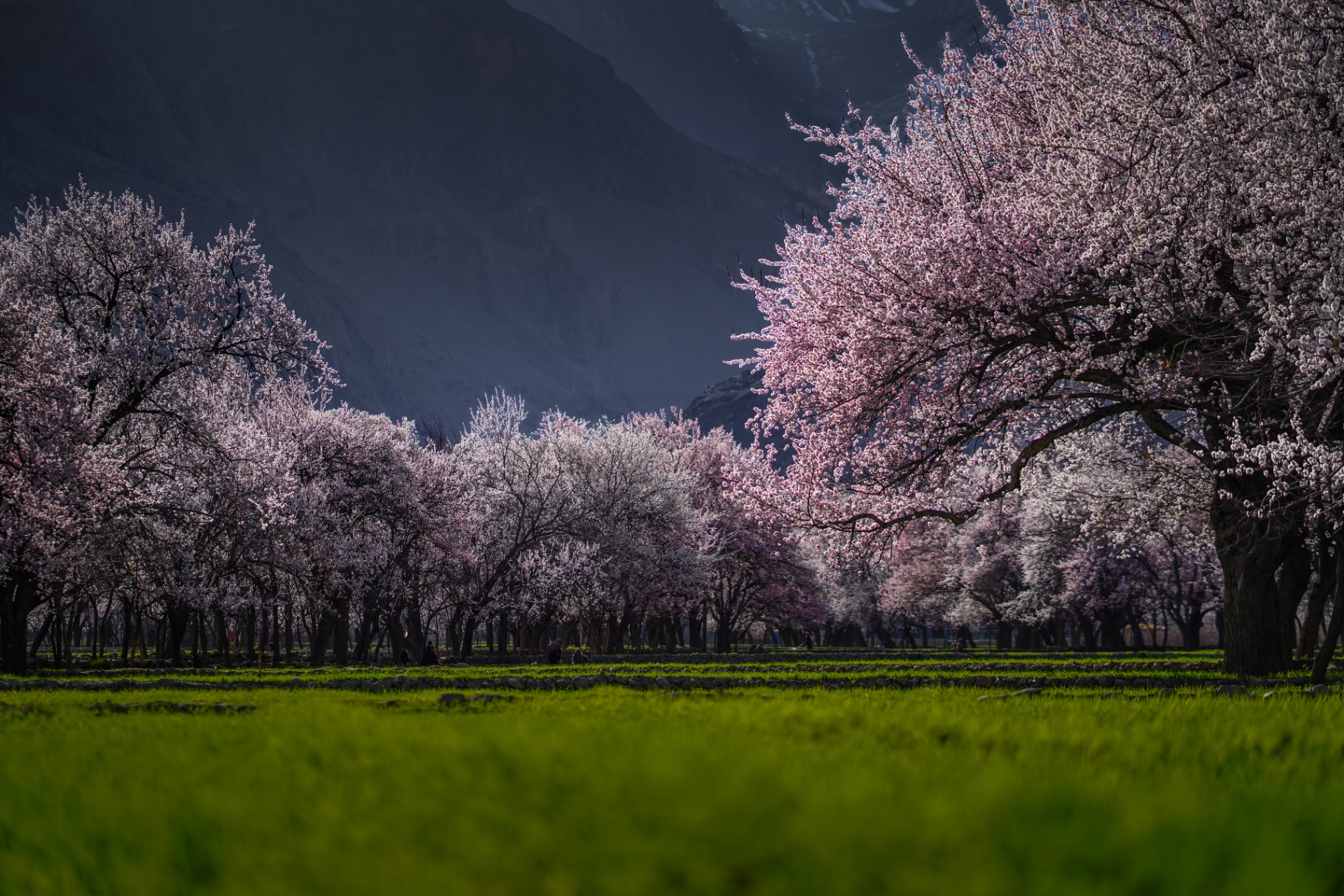
Spring in Baltistan is short and abrupt. The valley goes from bare grey to white and pink in about ten days, as the apricot, cherry and apple orchards come out along the irrigation channels, and then it is over. It is the single most photographed thing in the region and it is genuinely worth planning a trip around.
It is also the thing we most often have to be honest about. There is no official bloom forecast for Gilgit-Baltistan. Every tour company sells a fixed departure date; none of them knows. In practice the window most often falls from the last week of March into the middle of April, it moves by up to a fortnight depending on how the winter went, and the lower valleys colour before the higher ones — so Skardu and Shigar do not peak on the same day as Hunza. If a company tells you in November which week the blossom will be in, they are selling you a guess with a deposit attached.
What we tell guests who care about this: book a stay of five nights or more in the first half of April rather than a three-night hit on fixed dates, and accept that you may catch the beginning or the end rather than the peak. Nobody who has seen an orchard valley in bloom at any stage of it has complained.
Practically, spring is also mud season. The meltwater is running, the rivers are high and brown, and March is the wettest month of the year, though 37 millimetres would not count as a wet month anywhere else. Deosai is still firmly shut. The lakes, the forts and the cold deserts are all open and at their greenest.
If the blossom is the reason for the trip, talk to us before you fix the dates — we will tell you what the orchards are doing this week.
Call 0310 097311904
Summer, June to August: the only Deosai window, and the crowds
Hot, busy, and the one time the high plateau is reachable.
If Deosai National Park is the reason you are coming, summer is not a preference, it is the requirement. Snow shuts the plateau for most of the year and it becomes passable somewhere between late May and late June, then closes again with the first serious snow, usually from late September into October. There is no published opening or closing date, the variation between years runs to weeks rather than days, and the only reliable source is a driver who ran the road in the last few days. Deosai sits at roughly 4,000 metres, which is around 1,800 metres above the town, so it also belongs on day three of a trip rather than day one.
Summer is also when domestic tourism arrives in force. Pakistani school holidays put Skardu under real pressure through July and August: the bazaar is busy, drivers are booked out, the Kachura car park fills by mid-morning and every hotel in the valley is running at capacity. Book early, and book a driver at the same time as a room. Turning up in the second week of August expecting to arrange a jeep on the day is how people end up spending their trip in the bazaar.
The compensation is that everything is open. Every road on the list — Deosai, Shigar, Khaplu, Kachura, the Askole track for trekkers — is running, the passes are clear, and the days are long. If you are going anywhere near the Baltoro or K2 base camp, summer is the only season that exists.
One thing summer is not is a guarantee. Monsoon rain falling on the mountains south and west of Baltistan is what produces the landslides and flood damage that periodically cut the road links, as happened across Gilgit-Baltistan in July 2026. The Jaglot–Skardu Road and the Karakoram Highway were reported open again as of mid-August 2026, but a road that is open today can shut tomorrow, and the honest planning advice for July and August is to leave a spare day in the itinerary.
The same rain that makes the summer months awkward elsewhere is what puts Manthoka Waterfall in Kharmang at full flow, which is the one thing in the valley that is genuinely better in high summer than in autumn.
05
Autumn, September to November: the season we would pick
Clear air, warm days, cold nights and the roads to yourself.
“October is the month you can actually see the mountains you came for.”
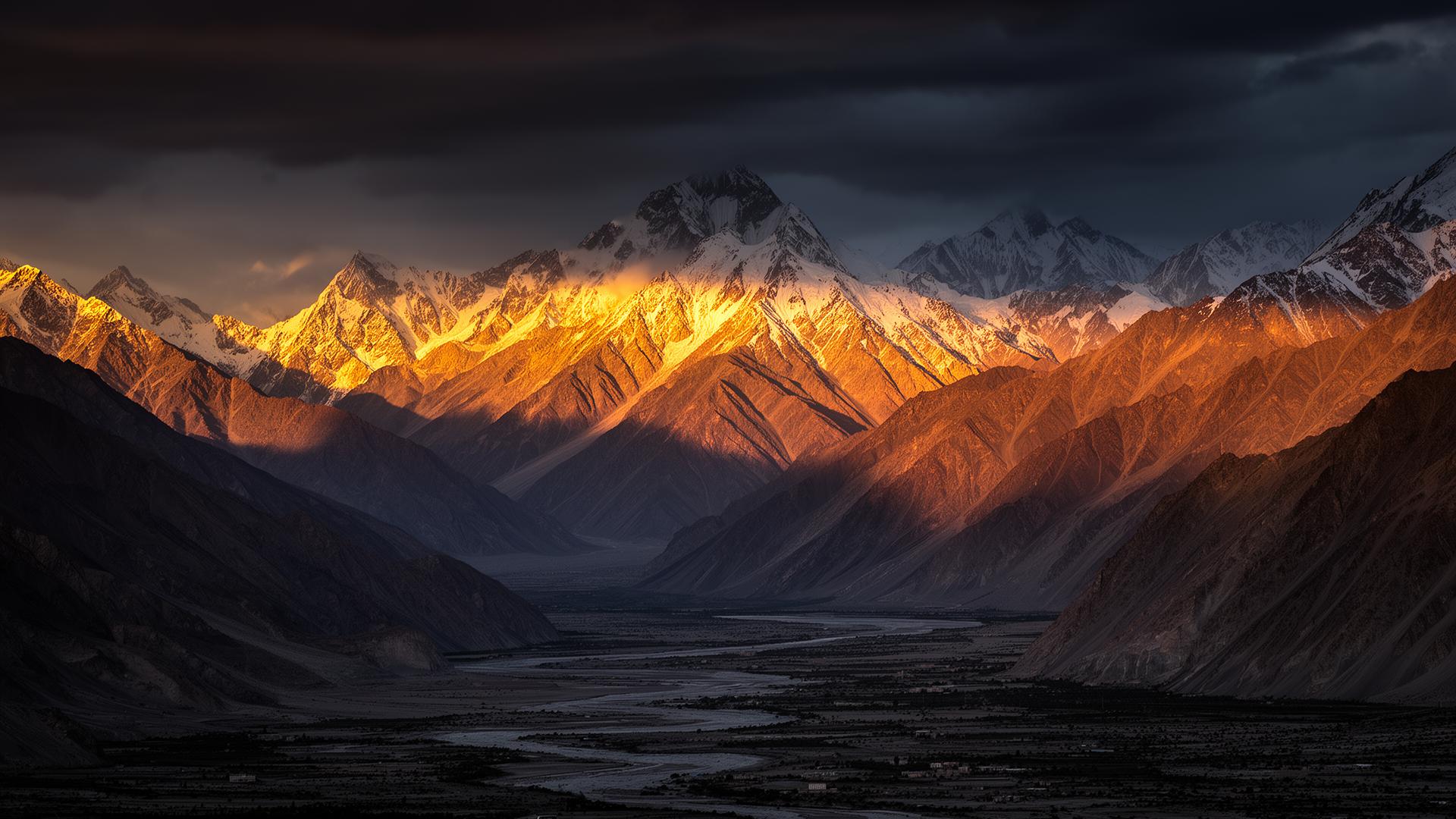
If someone asks us privately what the best time to visit Skardu is, the answer is late September and October, and it is not a close call. September still averages a high of 27.2°C and October 20.4°C, so the days are comfortable rather than hot. October is the driest month of the year at about 7 millimetres. The air after the summer haze is startlingly clear, which matters more here than almost anywhere: the reason to be in Baltistan is a horizon of eight-thousand-metre rock, and in October you can actually see it.
The valley also turns. The poplars along the channels go yellow, the orchards go red and gold, and the light in the last hour before sunset does things to the cold desert dunes that July light simply does not. Photographers who come once in summer come back in October.
The crowds have gone with the school holidays. Roads that were queuing in August are empty. Drivers who could not be booked in July have time to talk. And the nights get properly cold — October averages a low of 4.3°C and November drops to minus 1.9°C — which is only a problem if the building you are in cannot handle it.
The trade-off is Deosai. Early to mid-September is usually still fine; by late October the plateau is generally gone for the year, and nobody will commit to a date. If Deosai is essential, come in September rather than October. If it is optional, October is the better month in every other respect.
November is the quiet secret. Cold, bright, almost nobody there, the peaks holding fresh snow, and rates at their lowest before the winter proper. It is not a first-visit month. It is an excellent second-visit month.
Autumn fills quietly and later than people expect. Sixteen rooms go faster than sixteen sounds.
See the rooms and rates06
Winter, December to February: what actually closes
Less than the internet thinks, and more than you would like.
Winter in Skardu is real. January averages a low of minus 8°C and a high of 3.2°C, snow lies on the dunes, and the valley empties out completely. What surprises people is how much still works. The town does not shut. The bazaar trades. The Kachura lakes and the cold deserts are reachable in normal conditions, and snow on the Katpana dunes is the image that made the place famous in the first place.
What does close is the high ground. Deosai is gone entirely. The passes are shut. Anything involving a jeep track above the valley floor is off the table until spring.
The two things that genuinely bite in winter are flights and power. The approach into Skardu is visual and weather-dependent in every season, but in winter the odds of a cancellation rise sharply, and the road alternative is long and can itself be closed. If you fly up in January, do not book a same-day connection out of Islamabad on the way back. And load-shedding across the valley is a fact of winter life, which is why a hotel's generator matters more in January than its view does.
We keep the house open through winter and heat it properly, and we have written the long version of what that season is actually like separately, because it deserves more than a paragraph.
07
The things the month decides that the weather does not
Flights, roads, rates and how full the valley is.
Flights first, because they decide more trips than weather does. Skardu International Airport is served by scheduled flights from Islamabad, currently reported as operated by Pakistan International Airlines, Airblue and AirSial, on a route of a little over an hour. Schedules change seasonally and carriers come and go from the route, so confirm directly with the airline rather than trusting any list, including this one. What does not change is that the approach is visual: if the weather over the mountains is not good enough, the flight does not go, in July as well as in January. Build a buffer day.
The road is the fallback and it is a long one. Coming up from Islamabad, Lahore or Karachi by road is a two-day proposition for most people, and the state of the Karakoram Highway and the Jaglot–Skardu Road varies with the season and with what the last rain did. Both were reported open as of mid-August 2026. Neither is a promise about next month.
Rates follow demand rather than weather. July and August are peak because the schools are out; the shoulder months of May, September and October are better value for objectively better conditions; November through March is the cheapest time to sleep in Baltistan by a wide margin. That is the single most under-used piece of information in Skardu travel planning.
And crowding is not evenly spread. Even in August, the valley is busy between about ten and four and largely empty either side of that. A guest who takes breakfast at six and is at the dunes or the lake by seven has a completely different holiday from one who leaves at ten, in any month of the year.
Arcadian Hotel and Resort sits at Katpana, ten minutes from Skardu International Airport and ten minutes from the cold desert, with sixteen rooms in two types, a garden, a pool through the warm months, heating and a generator for the months when the valley loses power, and breakfast from six for people who want the place to themselves. Once you have settled on a month, the order you see things in matters just as much: our seven-day Skardu itinerary puts the flat days first and the altitude in the middle, which is the part most trip plans get backwards.
Choosing a month by what you actually want
- Deosai National Park
- Late June to mid-September. September is the sweet spot: open, and quiet.
- Blossom
- Late March to mid-April, undated and variable. Book a longer stay, not fixed days.
- Clear mountain views
- October, then November. September is close behind.
- Warm swimming weather
- June to August. The pool runs through the warm months only.
- Snow on the cold desert
- December to February, with the flight risk that comes with it.
- Lowest rates and no crowds
- November to March.
- Trekking and K2 base camp
- Summer only. The Askole track and the Baltoro are a June to September proposition.
Tell us which month you are thinking about and what you want out of it, and we will tell you honestly whether it works.
Ask the front deskGuest feedback
What guests actually say
We don't publish a star score of our own, because the only ratings worth reading are the ones we can't edit. Reviews for Arcadian Resort Skardu live on the booking platforms below, written by guests who paid for their rooms. Read them there, including the critical ones.
Location
Where Arcadian Resort actually is
Arcadian Hotel & ResortKatpana Road, Katpana, Skardu 15100
Gilgit-Baltistan, Pakistan 15100
0310 0973119
Arcadian Resort sits in Katpana, on the quiet side of Skardu: roughly ten minutes from Skardu Airport, ten minutes from the Katpana cold desert dunes, and fifteen to twenty minutes from the bazaar and Kharpocho Fort.
How we know this
The temperature and rainfall figures on this page are published climate averages for Skardu, not our own measurements, and they are averages rather than forecasts: any given week can sit well outside them. Everything about roads, flights, crowding and what is actually open comes from running a sixteen-room hotel in Katpana and from drivers and guests reporting back the same day. Where no official source publishes a date, most importantly the opening and closing of the Deosai road and the start of the blossom, we give the range and say plainly that nobody can date it in advance rather than inventing a week. Airline schedules to Skardu change seasonally and we name only carriers currently reported as operating the route, with the advice to confirm directly.
Reviewed: Each season, and after any road closure, flight suspension or major weather event in Baltistan.
Written and checked by the team that runs the house in Katpana, Skardu — the people who watch the Deosai road open and close, book the drivers, and answer the phone at midnight. Our editorial standards.
Sources
Where the figures come from
- Climates to Travel — Skardu climate ↗
- Source for the monthly average high and low temperatures and monthly rainfall quoted on this page.
- Gilgit-Baltistan tourism department ↗
- Regional tourism authority for Skardu and Baltistan, including road and district information.
- UNESCO World Heritage Centre — Deosai National Park (Tentative List) ↗
- Confirms Deosai is on Pakistan's Tentative List rather than inscribed as a World Heritage Site.
Questions
Common questions about when to visit Skardu
October, for most people. It is the driest month of the year, days average a high of about 20°C, the summer haze has cleared so the peaks are actually visible, the school-holiday crowds have gone and the valley turns gold. The catch is that Deosai National Park has usually closed for the season by late October. If the plateau matters to you, come in September instead — still clear, still quiet, and the road is normally still open. If you are coming for the blossom, none of this applies and you want early April.
Rooms & prices →Pick the month for the thing you actually came for
Deosai means summer. Blossom means early April. Clear air and empty roads mean late September and October. Snow on the dunes and nobody else in the valley means winter, with a flight you should not rely on. There is no month that gives you all of it, and the trips that go wrong here are almost always the ones booked around a season somebody read about rather than the one thing the traveller genuinely wanted to see.
Arcadian Hotel and Resort sits at Katpana, ten minutes from Skardu International Airport, with sixteen rooms, heating that works in January, a generator for when the valley does not, and breakfast from six in every season. To check availability, ask what the roads and the orchards are doing this week, or work out which month suits your trip, call or WhatsApp the front desk on 0310 0973119. If you are weighing the shoulder months specifically, our guide to Skardu in autumn goes month by month through September, October and November.
Keep reading