
01
Two lakes, one name, and the confusion that follows
Upper Kachura and Lower Kachura are not two views of the same water.
“Kachura is a place name, not a lake.”
The single most useful thing to understand before you set out is that Kachura is a place name, not a lake. Two separate bodies of water sit within a few minutes of each other, and they are owned, priced and experienced in entirely different ways. Booking a driver for "Kachura Lake" without saying which one is how people end up spending the morning at a resort gate they did not intend to pay at, or standing at a public car park wondering where the famous cottages went.
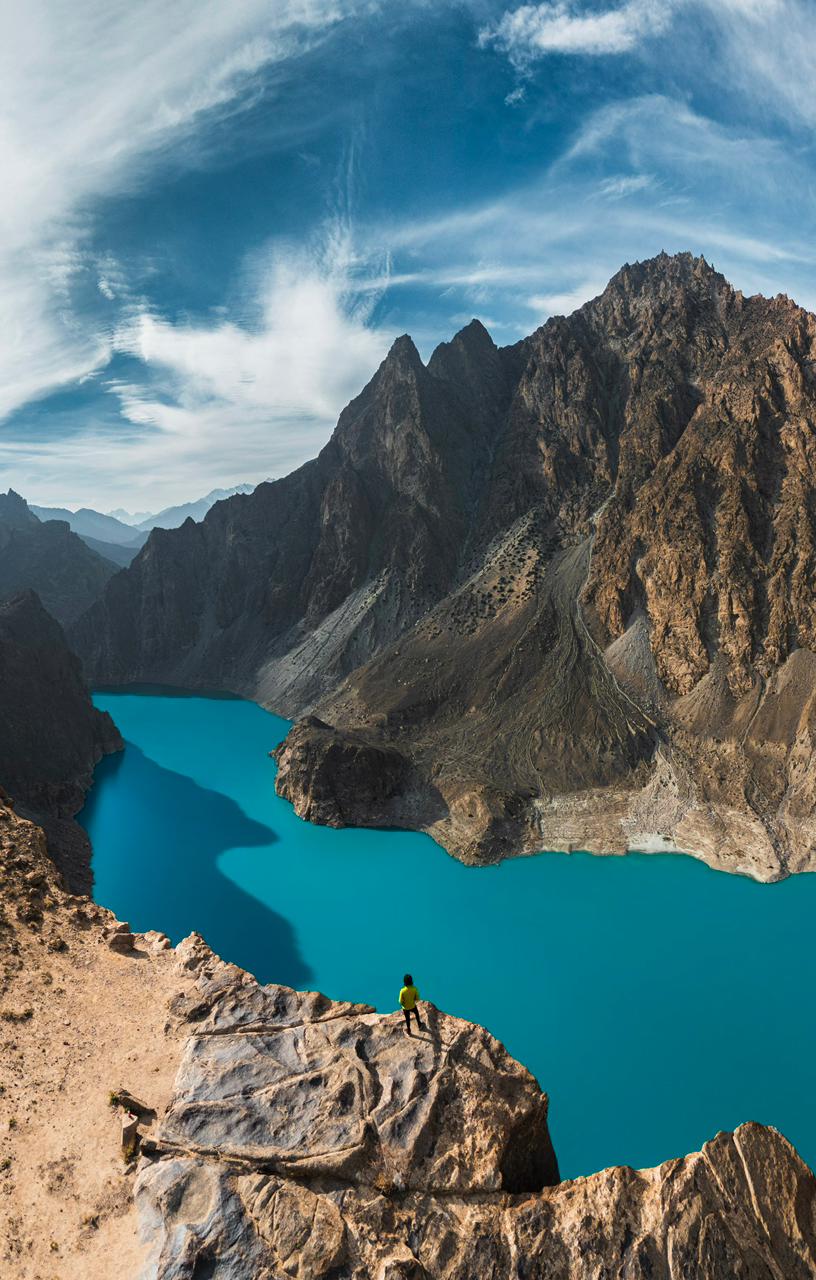
Upper Kachura, called Foroq Tso locally, is the deeper and wilder of the two. It is roughly seventy metres deep, it holds a summer temperature of around fifteen degrees Celsius, and in winter the surface freezes solid. You reach it by leaving the road and walking down a rough path through orchard and rock. There is no resort attached to it and no formal entrance.
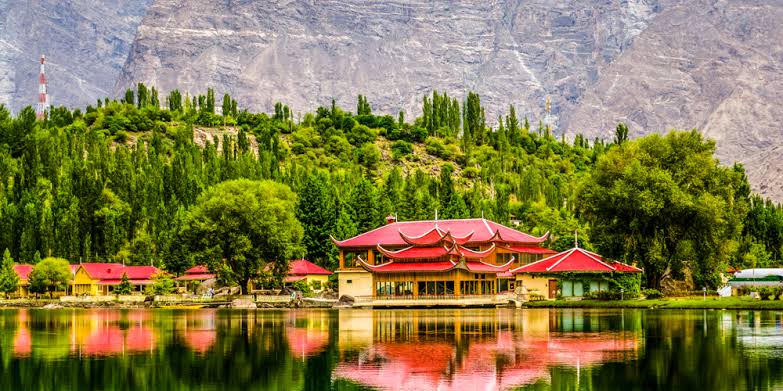
Lower Kachura is Shangrila Lake, and it lies inside the Shangrila Resort — a property established in 1983 and named, with some ambition, after the paradise in James Hilton's 1933 novel Lost Horizon. It is the lake in the photograph everyone has saved: heart-shaped, ringed with red-roofed cottages, with a restaurant built into the fuselage of an aircraft that came down nearby. It is beautiful and it is somebody's hotel. You visit it on their terms.
Which one should you actually go to?
If you want water, quiet and a short walk, go to Upper Kachura and go early. If you want lawns, a cup of tea, somewhere flat for children or older parents, and the photograph, go to Lower Kachura. If you have half a day, do both — they are close enough that the decision is really about the order, and the order should be Upper first, while it is still empty.
02
The road out: thirty kilometres, and nothing like the Deosai road
Kachura sits roughly thirty kilometres from Skardu town, and the drive takes about thirty-five to forty-five minutes depending on where in the valley you start and what the road is doing that week. It runs west out of Skardu on the Gilgit road, past the airport turn, along the Indus and up through Kachura village.
This is metalled road for almost the whole way and an ordinary car handles it without drama. That matters, because visitors who have read about the Deosai crossing arrive expecting to hire a 4x4 for everything. You do not need one for Kachura. A car and a driver who knows where the Upper Kachura path leaves the road is enough, and the second half of that sentence is the part that actually saves time.
The last stretch to Upper Kachura is the exception. The final approach and the walk down to the water are rough, unsurfaced and steep in places — fine in trainers in summer, genuinely slippery after rain or in early spring when meltwater is running across the path. Wear something with a sole.
From Katpana we are on the same side of Skardu as the road out, so the drive does not begin by crossing the bazaar. In July and August that is worth a quarter of an hour on its own.
Kachura from Arcadian, Katpana
- Kachura village
- Roughly 30 km — about 35 to 45 minutes by car on metalled road.
- Upper Kachura Lake
- A short, rough walk down from the car park. Allow 10 to 15 minutes each way.
- Lower Kachura (Shangrila)
- A few minutes on from Upper Kachura, entered through the resort gate.
- Between the two lakes on foot
- A connecting trail of roughly 25 to 30 minutes for those who want the walk.
- Skardu International Airport
- 10 minutes by car from the hotel.
Our drivers run this road year-round and know exactly where the Upper Kachura path leaves the tarmac.
Call 0310 097311903
Upper Kachura: the walk down, the cold water and the trout
Upper Kachura rewards the people who arrive first. Come at eight or nine in the morning in season and you will often have the far side of the water to yourself; come at one in the afternoon in August and you will share it with a good part of Skardu's day-trip traffic.
The water is startlingly clear and startlingly cold. Around fifteen degrees at the height of summer sounds mild written down; it does not feel mild when you are in it, and the lake is deep almost immediately from the edge. People do swim. If you are going to, do it in the middle of a warm day, stay close in, and understand that seventy metres of cold water directly below you is not a paddling pool.
Rowing and small motorboats operate seasonally, run by local operators at the water's edge rather than by any central authority. There is no published tariff — you agree a price before you get in, which is the local norm and not an attempt to catch you out. Agreeing it first is simply how it works.
Trout is the other reason people come. It is served at small setups near the lake and it is genuinely good. If you want to fish rather than eat, licensing runs through the Gilgit-Baltistan fisheries authorities and is best arranged before you drive out rather than negotiated at the shore.
04
Lower Kachura, or Shangrila: a lake with a gate on it
Lower Kachura is the postcard, and it is worth understanding that the postcard is private property. Shangrila Resort has run the site since 1983 and the lake is effectively its front garden. Day visitors are admitted, and a charge is collected at the gate.
What you get for it is a maintained lakeside: lawns, paths, boats, a tea house, and the DC-3 fuselage restaurant built from an aircraft that crashed nearby — which is either the region's best-loved oddity or its most photographed one, depending who you ask. It is flat, it is easy underfoot, and it is by some distance the better of the two lakes for grandparents, prams and anyone who does not want to scramble down a slope.
It is also, in high season, busy in a way that surprises people who came to the Karakoram for solitude. If quiet is the point of your trip, treat Shangrila as an hour rather than an afternoon, and put the quiet somewhere else in the day.
One thing worth saying plainly, since we are a hotel writing about another hotel: Shangrila is a good property and a genuinely historic one. We are not going to pretend otherwise. It is also thirty kilometres from Skardu, which is fine if the lake is your whole trip and less fine if you are flying out early, running day trips in three directions, or want to be ten minutes from the airport when the weather turns.
05
What it costs — and why we will not quote you a figure
“Anyone giving you a precise current number is repeating something they read.”
Here is where we have to be less useful than we would like. A day-visitor charge is collected at the Shangrila gate. Shangrila publishes no tariff on its own website, no regional authority publishes one either, and the figures quoted around the internet vary widely enough that anyone giving you a precise current number is repeating something they read.
So: carry cash in Pakistani rupees, expect the charge to be per person, expect vehicle entry to be handled separately, and expect the amount to have moved since the last article you read. Card payment at a gate in Baltistan is not something to plan around.
Upper Kachura has no formal entrance and no published fee, though small local charges for parking or access do get collected at times. Boating, food and fishing are all priced by whoever is providing them, agreed on the spot.
None of this is a scam and none of it is unusual. It is simply what a lightly regulated tourism economy looks like from the inside. Bring more cash than you think you need — there is no reliable ATM once you leave Skardu town, and the ones in town are not reliable either.
06
Season, and the hour of the day that actually matters
Kachura's great advantage over almost everything else people come to Skardu for is that it is open all year. Deosai is snowbound for six months. The Kachura road is not. That makes the lakes the reliable half-day in a valley where a lot of plans depend on a pass being clear.
April and May bring the blossom through the orchards on the approach and water levels running high with meltwater. June to August is the main season — warm, green, busy, and the only realistic window for swimming. September and October are, in our view, the best of it: the air clears, the crowds thin, the light goes long and gold in the afternoon, and the trout is still being cooked.
November through March is a different lake entirely. Upper Kachura freezes solid, and a frozen high-altitude lake under Karakoram rock is a genuinely extraordinary thing to stand beside. Access depends on snow on the last stretch of road, resort facilities at Lower Kachura run reduced or closed, and you will want proper boots. Ask before you commit the day.
As for the hour: go early. This is the single most repeated piece of advice we give and the one most often ignored. The lakes are east-facing enough that morning light is better, the water is stiller, the boats are free, and the coaches have not arrived. Breakfast at Arcadian starts at six precisely so that guests can be at Upper Kachura before anyone else.
The frozen upper lake is only one part of a much stranger season, and if you are considering the trip between November and February it is worth reading what is open in Skardu in winter before you commit to any of it.
07
The altitude detail almost every guide gets backwards
You will read, over and over, that Kachura is a gentle low-altitude option for your first day in Skardu. Half of that is right and the reasoning is wrong.
Skardu Airport sits at about 2,230 metres. The Kachura lakes sit at about 2,500. Kachura is not lower than Skardu — it is roughly two hundred and seventy metres higher. It is still an excellent first or second day, but for a different reason: the gain is small, the drive is short, the walking is optional, and you come back down to sleep. That is textbook gentle acclimatisation. It is not a rest at low altitude, because there is no low altitude here.
The practical version: if you have flown into Skardu that morning from the plains, a slow afternoon at Lower Kachura is a sensible use of the day. Save the scramble down to Upper Kachura, and certainly save any swimming, for day two. Headache, breathlessness on the walk back up and a bad first night's sleep are ordinary at this elevation and usually settle. They are also your body telling you not to add a thousand metres tomorrow.
Guests who plan Skardu properly tend to do it in this order: arrive and do nothing, Kachura and the dunes on day two, and the high ground — Deosai, the passes — from day three onward, once the valley has stopped feeling like hard work.
08
Where Kachura fits in a Skardu week
Kachura is a half-day, not a day. Treating it as a full day is the most common scheduling mistake we see, and it costs people an afternoon they could have spent on the Indus, in the bazaar, or asleep.
The pairing that works best is Kachura in the morning and the cold desert in the late afternoon — two completely different landscapes, both close, with the middle of the day spent somewhere with a roof. Alternatively, Kachura and the Shigar road make a natural pair heading north, with Blind Lake on the Shigar side as a detour for anyone who wants a third body of water and a rougher track to reach it. Shigar Fort is the obvious anchor for that direction, an hour of flat valley floor from Skardu and worth a morning in its own right.
What Kachura is not is a substitute for Deosai. People occasionally swap one for the other when a plan tightens; they are not comparable. Kachura is an accessible, beautiful, well-visited pair of lakes half an hour from town. Deosai is a four-thousand-metre plateau and a serious day out.
Arcadian sits at Katpana, ten minutes from Skardu International Airport and on the western side of town, which is the side the Kachura road leaves from. Sixteen rooms in two types, a garden, a pool through the warm months, and a front desk that will tell you honestly whether the walk down to Upper Kachura is worth it in the weather you have got.
If you have a week rather than a few days and want a third kind of water, Manthoka Waterfall down the Kharmang road is the long-day option — four to five hours in the car, but a valley almost nobody else drives.
Sixteen rooms, breakfast from six, and drivers who ran the Kachura road this week.
See the rooms and ratesGuest feedback
What guests actually say
We don't publish a star score of our own, because the only ratings worth reading are the ones we can't edit. Reviews for Arcadian Resort Skardu live on the booking platforms below, written by guests who paid for their rooms. Read them there, including the critical ones.
Location
Where Arcadian Resort actually is
Arcadian Hotel & ResortKatpana Road, Katpana, Skardu 15100
Gilgit-Baltistan, Pakistan 15100
0310 0973119
Arcadian Resort sits in Katpana, on the quiet side of Skardu: roughly ten minutes from Skardu Airport, ten minutes from the Katpana cold desert dunes, and fifteen to twenty minutes from the bazaar and Kharpocho Fort.
How we know this
We run a sixteen-room hotel in Katpana, on the western side of Skardu, and we send guests out to Kachura through most of the year — usually on the first or second morning of a trip. Road conditions, drive times, the state of the walk down to Upper Kachura and what day visitors are actually asked for at the Shangrila gate come from our own drivers and from guests reporting back the same week. Elevation, depth and the freezing of the upper lake are taken from the published sources listed above. Where a figure is not officially published — most importantly the gate charge — we say so rather than repeating a number from a blog.
Reviewed: Each season, and whenever the gate arrangements at Shangrila change.
Written and checked by the team that runs the house in Katpana, Skardu — the people who watch the Deosai road open and close, book the drivers, and answer the phone at midnight. Our editorial standards.
Sources
Where the figures come from
- Shangrila Resorts, official site ↗
- The operator of Lower Kachura Lake. Publishes no day-visitor tariff, which is why we do not quote one.
- Gilgit-Baltistan tourism department ↗
- Regional tourism authority for Skardu District and the Kachura lakes.
- Upper Kachura Lake — elevation, depth and winter freeze ↗
- Source for the 2,500 m elevation, 70 m depth and summer water temperature.
Questions
Practical Questions About Kachura Lake
Roughly thirty kilometres, which is about thirty-five to forty-five minutes by car depending on where in the valley you start. The road runs west out of Skardu on the Gilgit road, past the airport turn and along the Indus. It is metalled almost the whole way and an ordinary car is fine — you do not need the 4x4 you would want for Deosai. Only the final approach to Upper Kachura and the footpath down to the water are rough.
Rooms & prices →Plan Kachura around the morning
Kachura asks very little of you compared with the rest of Baltistan — no 4x4, no permits, no season to wait for, no altitude to fear. It asks for one thing, which is that you get up. Early light on Upper Kachura before the road fills is a genuinely different lake from the one most visitors photograph at two in the afternoon.
Arcadian Hotel & Resort sits at Katpana, ten minutes from Skardu International Airport and on the side of town the Kachura road leaves from. Breakfast runs from six for exactly this kind of morning. To check availability, ask what the road and the walk down are doing this week, or arrange a driver, call or WhatsApp the front desk on 0310 0973119.
Keep reading