
01
Two thousand two hundred metres to four thousand, in ninety minutes
“It is really an altitude event with a drive attached.”
The single most useful fact about Deosai is not its beauty. It is the rate of climb. Skardu Airport sits at 2,230 metres and the town a little above that. The Deosai plains average 4,114 metres, and Sheosar Lake sits at roughly 4,150 metres. That is a gain of about 1,900 metres, and the road does it fast.
A day trip breaks every rule of gradual ascent — but you descend the same evening, which is the saving grace. The problem is guests who fly into Skardu in the morning, sleep one night, and drive up the next day. They have not acclimatised to Skardu, let alone to 4,100 metres.
Our advice is free: give Skardu two nights before Deosai, and spend the first day low and flat — the Katpana dunes, the bazaar, Satpara Lake. Headache, nausea and poor sleep on your first night here are your body saying the plateau can wait a day. The Kachura lakes are the usual answer for that first day — a short drive, a small altitude gain and no commitment to a mountain.
What altitude actually feels like up there
Most healthy visitors get a headache and shortness of breath on the climb and feel fine again on the way down. What matters is recognising the line: confusion, loss of coordination, or a cough that will not settle are not "tired" — they are reasons to turn the vehicle around. Descent is the treatment, and there is no clinic on the plateau.
02
The road: Sadpara, Ali Malik Mar, and why a 4x4 is not optional
From Skardu the route runs south past Satpara Lake, climbs a series of switchbacks to the Ali Malik Mar pass — the tea stop most drivers call Deosai Top — and then opens onto the plateau at Bara Pani and Kala Pani. Sheosar Lake is the far end of the crossing.
Distance to the plateau edge is short, around thirty kilometres, but expect an hour and a half to two hours. Reaching Sheosar and returning is a full day. The tarmac ends not long after Satpara; what follows is unpaved, rutted, and steep in places, with river crossings that change with snowmelt.
A 4x4 with a local driver is genuinely required, not merely recommended. You will read the occasional traveller report saying a car managed it. Do not plan on being that traveller — a vehicle stuck past the pass is a long, cold problem with no recovery service behind it.
One note on Satpara Lake as you pass: the Satpara Dam turned it into a reservoir, so its level rises and falls with dam operation. If it looks nothing like the photograph you saved, that is why. Older articles describing the lake as drying up predate the dam.
Drive times from Arcadian, Katpana
- Satpara Lake
- About 25 minutes by car — the last easy stretch before the climb.
- Ali Malik Mar pass (Deosai Top)
- Roughly 1.5 to 2 hours by 4x4 from Skardu.
- Bara Pani
- About 2 hours, on the plateau proper.
- Sheosar Lake
- A full day out and back from Skardu.
- Skardu Airport
- 10 minutes by car from the hotel.
03
When the park is open, and how much that date moves
Deosai is snowbound from roughly November through May. It generally becomes passable somewhere around mid-June and closes again in October, though the exact dates move by weeks from year to year and no authority publishes them in advance.
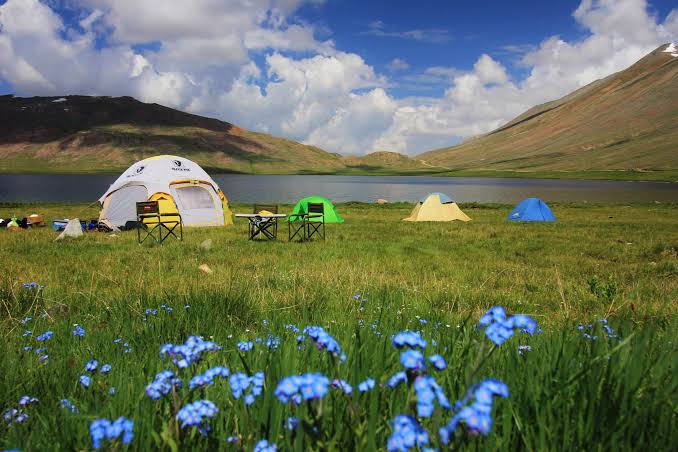
Late June through September is the dependable window. July and August give you the wildflowers the plateau is famous for; September gives clearer air and fewer vehicles, at the cost of colder nights and a shorter margin before the first snow.
Do not book a Deosai day around a date you found in a blog. Ask in Skardu the week you arrive — our front desk checks with drivers who ran the road that morning, which is the only source that is ever current.
From roughly November the Deosai road is gone under snow and the question becomes what is left, which we have set out separately in our guide to Skardu in winter.
04
Fees, permits and the paperwork nobody can pin down
“Anyone quoting you a precise current figure is repeating a blog.”
This is where we have to be honest rather than useful. A fee is collected at the park gate, tiered between Gilgit-Baltistan residents, other Pakistani nationals, and foreign visitors. What that fee actually is, we cannot tell you with confidence.
No official tariff is published by the Gilgit-Baltistan Forest, Wildlife and Environment Department or the regional tourism department, and the amounts reported by travellers and travel sites over the last few years differ by a factor of five. Anyone quoting you a precise current figure is repeating a blog.
What we can tell you: carry cash in Pakistani rupees, carry more than you think, and expect foreign visitors to be charged at a noticeably higher rate. Card payment at a gate on a plateau is not a thing.
Permits are simpler. Pakistan removed the No Objection Certificate requirement for foreign visitors to Gilgit-Baltistan in 2019. For Deosai you need a valid Pakistani visa and the gate fee — nothing else. The NOC requirement does still apply to some border-adjacent areas and to Baltoro and K2-side trekking, so if Deosai is one leg of a bigger mountain itinerary, check that separately.
05
What changed in 2025: camping and the commercial ban
If you are reading older guides, they will tell you to camp at Bara Pani. Do not plan on that without checking first.
In September 2025 the Gilgit-Baltistan Wildlife Department banned private camping in the park after a visitor was injured by a brown bear near Bara Pani while camped in a restricted area. In December 2025 the Forest, Parks and Wildlife Department issued a further notification banning seasonal hotels and commercial activity inside the park boundary, with legal action threatened against operators.
Whether private camping is permitted again this season we do not know, and we would rather say so than guess. Confirm with the Wildlife Department office in Skardu before planning an overnight, and whatever the rule turns out to be, do not camp outside a designated zone: this is active brown bear habitat and the 2025 incident was not theoretical.
For most visitors it changes little. Deosai works well as a long day from Skardu, and a heated room at the end of it beats a tent at 4,100 metres in any case.
Ask the front desk what the Deosai road and the camping rules are doing this week.
Call 0310 097311906
What the plateau is actually like
Deosai is not a viewpoint. It is 3,584 square kilometres of treeless high tundra, and the scale is the point — you drive for an hour and the horizon does not appear to move.
July and August daytime temperatures typically sit somewhere in the teens Celsius, and nights drop to around freezing or below even at the height of summer. Weather changes fast and there is no shelter. Every year someone arrives in a t-shirt because Skardu was warm at breakfast.
The park's headline resident is the Himalayan brown bear, which recovered from around twenty animals in the early 1990s to roughly seventy-eight at the most recent count we can find, from 2022. You are unlikely to see one and should not try. Golden marmots you will see everywhere. Tibetan wolf, Himalayan ibex, Tibetan red fox and snow leopard are all recorded here, along with golden eagles and Himalayan griffon vultures.
One correction worth making, because it appears on a lot of travel sites: Deosai is not a UNESCO World Heritage Site. It was added to Pakistan's UNESCO Tentative List in April 2016 — a nomination, not an inscription.
07
The other way in: Astore and Chilim
Deosai has a second entrance. From Astore the road runs through Chilim — the last settlement before the park — and reaches Sheosar Lake first, reversing the usual order of the crossing. It is longer and rougher: roughly seventy kilometres and three to five hours by 4x4.
Crossing the whole plateau between Skardu and Astore is around 152 kilometres and a serious full day. Some travellers use it as a route onward toward the Astore valley rather than as a return day trip, which is a good use of a hard road — you get the plateau and you make progress.
If you are coming up from the plains rather than flying, our route guides cover the journey before you get anywhere near Deosai.
08
What to carry, and what there is none of up there
There is no fuel between Skardu and the park, and none inside it. Fill the tank in Skardu the evening before — peak-season shortages in town are common enough that the morning of departure is too late.
Assume no mobile signal on the plateau. In Skardu itself SCO has the most reliable coverage, with Zong the strongest of the commercial networks; none of that helps past the pass. Download offline maps and tell someone at your hotel what time you expect to be back. We keep a note of it.
Carry more water than a day in the plains would need, layers including a proper windproof, sun protection — the UV at 4,100 metres is fierce even when the air is cold — and food. Our kitchen sends guests off with something hot in a flask and bread, because there is nowhere to buy lunch and the last thing you want at altitude is a skipped meal.
What to have in the vehicle
- Fuel
- Full tank from Skardu. Nothing between the town and the park, or inside it.
- Cash
- Pakistani rupees for the gate. No card payment.
- Layers
- Windproof shell and warm mid-layer even in August.
- Food and water
- Nothing is sold on the plateau. We pack a flask and bread.
- Offline maps
- Assume no signal past the pass.
09
Planning the Deosai day from a bed in Skardu
Deosai is the reason most people give for coming to Skardu, and it is the part of the trip most often planned badly — flown in on Monday, driven up on Tuesday, wondering why Tuesday was miserable.
The version that works: land, sleep, spend a day low, go up on day three, come back down and eat properly. Arcadian sits at Katpana, ten minutes from the airport and on the side of town the Deosai road leaves from. We start breakfast at six for exactly this reason, and the front desk will find you a driver who ran the road recently rather than last season.
Flights into Skardu are operated by PIA, Airblue and AirSial from Islamabad, with some service from Lahore and Karachi. It is a visual-approach airport, so cancellations are ordinary — build a buffer day and keep the road route in mind as a fallback.
For the low day before Deosai, the two options we suggest most are Kachura in the morning or an hour north to Shigar Fort, both of which stay at roughly valley height and leave your legs and your lungs alone. If you are also planning the run east to Khaplu, put the two-day trip up the Shyok valley either side of Deosai rather than next to it — both days are long and neither improves the other. Deosai is a day four problem rather than a day two one, and our seven-day Skardu itinerary shows exactly which low days should come before it.
Two room types, sixteen rooms, and breakfast from six for the early start.
See the roomsGuest feedback
What guests actually say
We don't publish a star score of our own, because the only ratings worth reading are the ones we can't edit. Reviews for Arcadian Resort Skardu live on the booking platforms below, written by guests who paid for their rooms. Read them there, including the critical ones.
Location
Where Arcadian Resort actually is
Arcadian Hotel & ResortKatpana Road, Katpana, Skardu 15100
Gilgit-Baltistan, Pakistan 15100
0310 0973119
Arcadian Resort sits in Katpana, on the quiet side of Skardu: roughly ten minutes from Skardu Airport, ten minutes from the Katpana cold desert dunes, and fifteen to twenty minutes from the bazaar and Kharpocho Fort.
How we know this
We run a sixteen-room hotel in Katpana, ten minutes from where the Deosai road leaves Skardu, and we send guests up it through most of the open season. Route timings, road conditions and seasonal dates here come from our own drivers and guests. Altitudes, park area, wildlife counts and regulatory changes are taken from the government and UNESCO sources listed above. Where a figure could not be verified — the gate fee, the exact season dates, the current camping rules — we say so rather than guessing, and we tell you who to ask instead.
Reviewed: Each season, and immediately after any reported closure or reopening of the Sadpara road.
Written and checked by the team that runs the house in Katpana, Skardu — the people who watch the Deosai road open and close, book the drivers, and answer the phone at midnight. Our editorial standards.
Sources
Where the figures come from
- Gilgit-Baltistan Forest, Wildlife and Environment Department ↗
- Park authority for Deosai — wildlife, protection status and the 2025 camping notifications.
- Gilgit-Baltistan tourism department ↗
- Regional tourism listing for the park. No gate tariff is published here, which is why we do not quote one.
- UNESCO World Heritage Tentative List — Deosai National Park ↗
- Added April 2016. A nomination, not an inscription — Deosai is not a World Heritage Site.
Questions
Practical Questions About the Deosai Road
Around ninety minutes to two hours to reach the plateau edge via the Satpara road, covering roughly thirty kilometres — the distance is short but the surface is unpaved and steep. Continuing to Sheosar Lake and back makes it a full day. Leave Skardu by six or seven in the morning for the best light and a comfortable margin to be back before dark, which matters on a road with no lighting and no recovery service.
Rooms & prices →Plan the Deosai day properly
Deosai rewards patience more than any other trip out of Skardu. Two nights in the valley first, a driver who ran the road this week, a full tank, warm layers and food you brought with you — that is the whole formula, and it is mostly about not being in a hurry.
Arcadian Hotel & Resort sits at Katpana, ten minutes from Skardu Airport and on the right side of town for an early start. Breakfast runs from six. To ask about availability or what the Deosai road is doing right now, call or WhatsApp the front desk on 0310 0973119. If you are travelling in September or October, read how the autumn closure actually works before you fix the date.
Keep reading