
01
Where the Sarfaranga cold desert actually is
North-east of Skardu, on the Shigar road — not west, where Katpana is.
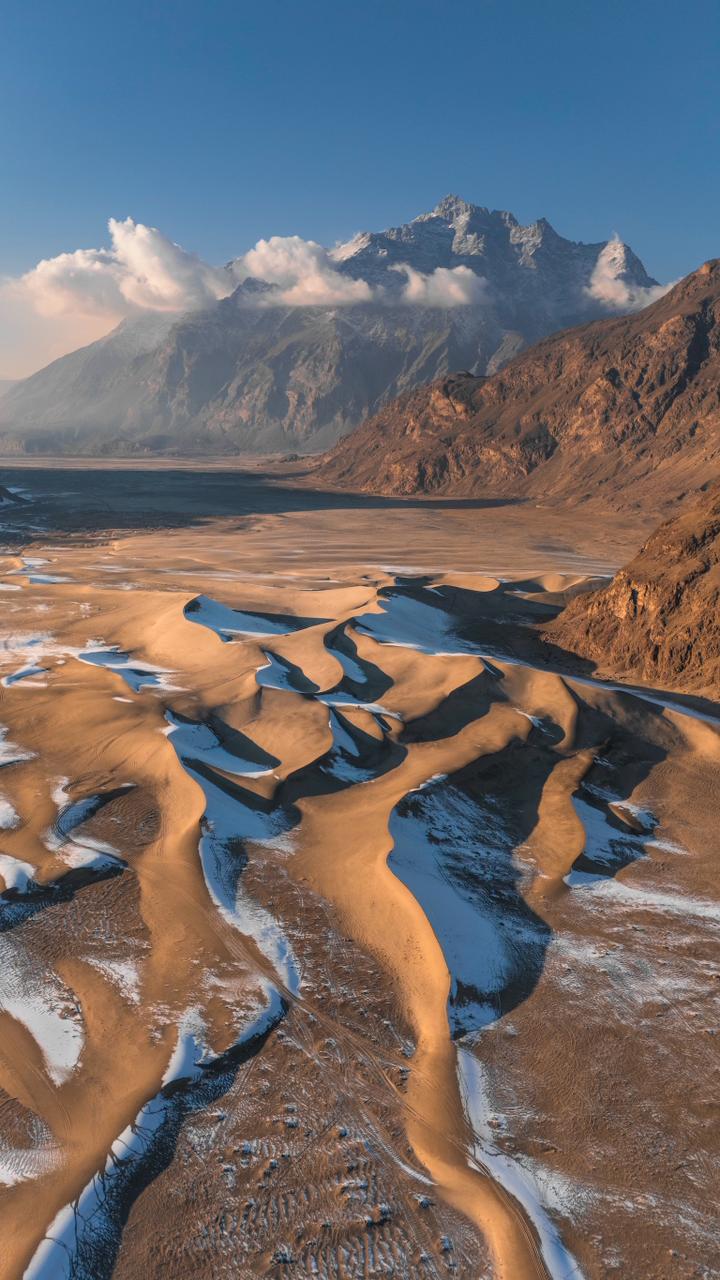
Get the direction right first, because half the confusion about Skardu's deserts is geographic. Sarfaranga lies north-east of Skardu, on the road toward Shigar, out where the Shigar valley opens into the Skardu bowl and the river braids across gravel before joining the Indus. It takes its name from Safaranga village, a settlement of roughly 1,500 people at its eastern corner along the Shigar river.
The published figure for the drive is about twenty kilometres and thirty minutes from Skardu town. Treat that as the floor rather than the answer: it is thirty minutes on a good day with nothing in the way, and longer whenever the bazaar is busy or you are stopping for photographs, which you will be.
The road is metalled effectively the whole way and an ordinary saloon car manages it. That is worth saying, because people arrive in Skardu having read about the Deosai crossing and assume every trip out of the valley needs a 4x4. Sarfaranga does not — to get there. Driving onto the open sand is a different proposition, and it is where saloon cars get buried up to the sills. Park at the edge, walk in, and let the jeeps do the jeep things. From Katpana we sit on the Skardu side of the confluence, so this run does not begin by crossing the bazaar — on a July morning that is worth a real amount of time.
Sarfaranga at a glance
- Where
- Shigar district, Gilgit-Baltistan, where the Shigar river meets the Indus.
- Distance from Skardu
- About 20 km; roughly 30 minutes on metalled road.
- Elevation
- Around 7,500 ft (about 2,300 m) — close to Skardu's own altitude.
- Vehicle
- An ordinary car reaches the edge; 4x4 only for driving on the sand itself.
- Access season
- Year-round. The Shigar road does not close the way the Deosai plateau does.
- Entry fee
- No officially published charge for the desert itself.
- Facilities
- Effectively none — no shade, no fuel, no reliable food on the sand.
02
Sarfaranga or Katpana? The two cold deserts, told apart
Two stretches of sand on opposite banks of the Indus, routinely sold as one.
This is the single most useful thing on this page, and almost nobody writes it down clearly. Skardu has two famous stretches of cold desert, and they are not the same place. The Indus separates them: the Katpana dunes lie on the left bank, and Sarfaranga on the other side of the water where the Shigar valley opens out.
Neither is better; they answer different questions. If you have one hour and no car, you want Katpana — which is why we tell guests to walk out before breakfast rather than book anything. If you have half a day and are already going north to the fort, you want Sarfaranga: an open plain rather than a pocket of dunes, and the sense of standing on sand with eight-thousand-metre country behind you lands harder there.
What annoys us is watching a visitor book a cold desert tour, get driven to whichever one the driver prefers, and never learn there were two. Ask which one you are being taken to, and ask what time you will arrive.
Katpana cold desert
West of Skardu, beside the airport road and minutes from town — ten minutes' walk from our own gate. Smaller dunes tucked against the valley wall. Best as a dawn walk before breakfast, or at last light after a day out. No rally, and far fewer vehicles.
Sarfaranga cold desert
North-east on the Shigar road, about twenty kilometres out and roughly thirty minutes by car. A wide, open sand plain with the river braiding beside it. Best as a half day, usually paired with Shigar. This is where the annual Cold Desert Rally is held.
03
The altitude, and the world's highest cold desert claim
Roughly Skardu's own height — which is the part that matters for planning.
You will see Sarfaranga called the highest cold desert in the world almost everywhere, including in the national press: Dawn describes it as known as the world's highest cold desert, perched at an elevation of 7,500 feet in the Shigar district. We repeat the elevation because it is consistently published. We are more careful with the superlative — it is a widely used description rather than something we can verify against any register of cold deserts, and we would rather you heard that from us than discovered it later.
The practical translation is more useful than the ranking. Sarfaranga sits at roughly the same height as Skardu town, which means it costs you almost no altitude gain. That makes it one of the few outings that is genuinely sensible on your first or second day in Baltistan, when the Deosai plateau at around 4,000 metres would be a poor idea. Fly in, sleep a night, and the dunes are a reasonable next morning. Deosai is not.
The climate is the other half of that story. Summers here are mild and dry; winters are not. Published accounts put winter temperatures below −25°C, and wind on an open sand plain removes whatever margin you thought you had. Snow lying on dunes is the photograph that made Skardu's cold deserts famous, and it is real — but the people who get it are dressed for a glacier, not a desert.
04
The two hours that matter
Sand is a lighting problem before it is a destination.
“The dunes cost an hour at the right hour and nothing at all at the wrong one.”
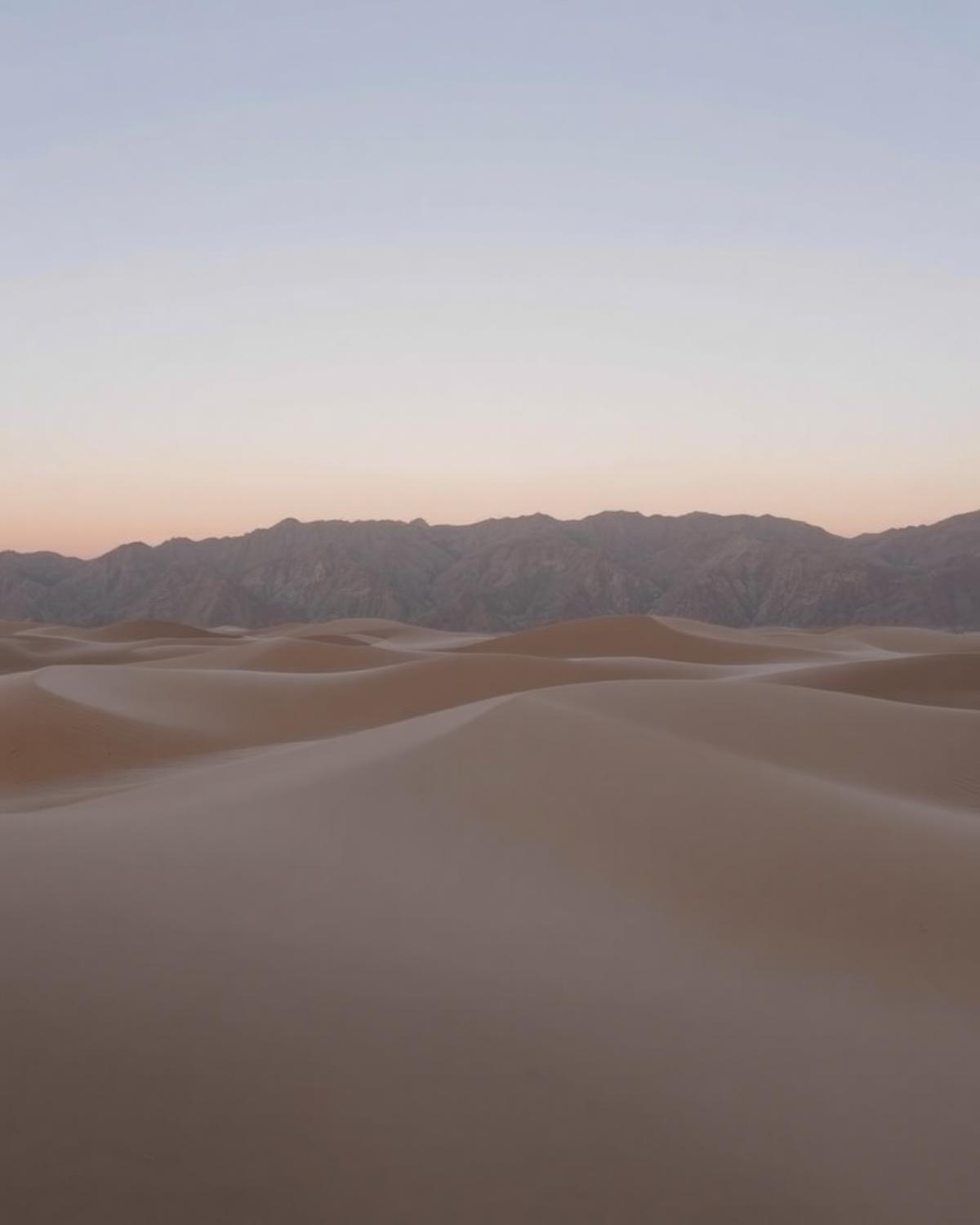
At midday Sarfaranga is flat, glaring and, frankly, a little boring — the dunes lose their edges and the whole plain reads as grey-brown haze. In the first hour after sunrise and the last hour before sunset, the same ground turns into ridges and shadow with the Karakoram catching light behind it.
So the honest scheduling advice is: do not go at one o'clock. Go early, or build it into the end of a Shigar day so you are crossing the sand as the light drops. The pairing we suggest most often at the front desk is Shigar Fort in the morning, lunch in the valley, and the dunes on the way home — which puts the flattest, least photogenic part of a Baltistan afternoon inside the car, where it belongs.
Two things the guides skip. The wind gets up most afternoons and fine sand goes everywhere — lenses, zips, the door seals of a rented car — so bring a bag you can actually close. And there is no shade at all: no trees, no shelter, nothing to sit behind. At this altitude the sun is fierce even when the air is cold, and people who judge sun exposure by temperature get burned here more often than anywhere else we send guests.
05
The Sarfaranga Cold Desert Rally, and what it does to the valley
Held annually since 2017, usually in the first half of October.
Once a year the quiet plain becomes the loudest place in Gilgit-Baltistan. The Sarfaranga Cold Desert Rally has run annually since 2017, and it has grown from a regional motorsport event into a multi-day festival the provincial government now treats as a tourism fixture.
The scale is worth understanding before you book around it — or away from it. At the fourth edition in October 2022, Dawn reported 50 jeep racers including five women in a qualifying round over a two-kilometre course, with 60 jeep drivers and 25 bikers contesting a 30-kilometre final. By the fifth edition a year later, over 100 racers from across the country were running an 80-kilometre track, with 18 local drivers including three women, 135 stalls selling local food, gemstones and handicrafts, and around Rs 23 million of private-sector business across three days. Arab News put the figure at $825,994.
Around the racing sit a motorbike race, a zakh raft competition on Blind Lake, free-style polo, sword dances, tent pegging, paragliding and the Mayfang fire festival — which is genuinely the more interesting half if you are not a motorsport person.
Recent editions have fallen in the first half of October, and the organisers' own material advertised 6 and 7 October for the 2025 event. We are not going to print a date for the next one, because at the time of writing no confirmed date has been published, and a wrong date on a page like this sends somebody across Pakistan for nothing. Check the organisers directly, and ask us — we hear about it in Skardu before it reaches the internet.
What it means practically. If you want the rally: book accommodation in Skardu early and expect the valley to be full. Rally week is the single busiest stretch of the Skardu year outside the summer peak, hotels of every standard fill, and the flights from Islamabad fill with them. This is not the week to arrive hoping to find a room. If you want empty dunes: avoid that fortnight entirely. October is otherwise one of the best months in Skardu — clear air, gold poplars, the crowds gone — and the rest of the month gives you the sand to yourself.
Rally week fills the valley. If your dates are anywhere near it, book early and ask us what we are hearing.
Check availability06
What the day actually takes, from Katpana
Cash, closed shoes, a layer, and a price agreed before you get on the machine.
Leave after breakfast, or leave late in the afternoon. Breakfast at Arcadian runs from six, which on this trip is not hospitality so much as arithmetic — the first light on the sand is the reason to go at all.
Take cash in rupees. There is no ATM out there and no card machine, and the ATV and dirt-bike operators who appear on the sand in season deal in notes. We are not going to quote you a rate for a quad bike or a jeep ride. Every figure circulating online is somebody's receipt from a year or two ago, and what you are offered depends on the season, the hour and whether the rally is on. Agree the price before you get on the machine, not after.
Wear closed shoes you do not mind emptying, take more water than the temperature suggests, and take a layer even in July, because the moment the sun drops behind the ridge the plain goes cold quickly. Camping on the sand is possible and people do it, particularly around the rally; there are no facilities, so anything you want you carry in, and everything you carry in comes out again with you.
That last point is not a formality. These dunes take more visitors every year, and the rubbish left behind after a busy weekend is visible from the road. The valley is small. Take your bags home.
Sixteen heated rooms ten minutes from the airport, breakfast from six, and a front desk that will tell you whether the light is worth the drive this week.
See the rooms and ratesGetting around
Sarfaranga and the rest of the day, from Arcadian at Katpana
Drive times are from Katpana, on the western side of Skardu. They assume a clear run and daylight.
| Place | Approx. travel time | Why go |
|---|---|---|
| Katpana cold desert | About 10 minutes' walk | The other cold desert — smaller, closer, and best before breakfast. |
| Sarfaranga cold desert | About 30 minutes | Roughly 20 km on metalled road; park at the edge of the sand. |
| Shigar Fort | About an hour | Same road. The natural pairing: fort in the morning, dunes at last light. |
| Skardu International Airport | About 10 minutes | Why the dunes work on the day you land, when Deosai does not. |
| Deosai plateau | A full day | Around 4,000 m, season-locked, and best left until your third day. |
Guest feedback
What guests actually say
We don't publish a star score of our own, because the only ratings worth reading are the ones we can't edit. Reviews for Arcadian Resort Skardu live on the booking platforms below, written by guests who paid for their rooms. Read them there, including the critical ones.
Location
Where Arcadian Resort actually is
Arcadian Hotel & ResortKatpana Road, Katpana, Skardu 15100
Gilgit-Baltistan, Pakistan 15100
0310 0973119
Arcadian Resort sits in Katpana, on the quiet side of Skardu: roughly ten minutes from Skardu Airport, ten minutes from the Katpana cold desert dunes, and fifteen to twenty minutes from the bazaar and Kharpocho Fort.
How we know this
We run a sixteen-room hotel in Katpana, on the Skardu side of the confluence, and our drivers run the Shigar road most weeks of the year. What the dunes are like at different hours, which pairings make a sensible day, and what happens to the valley during rally week come from us and from guests reporting back the same evening. Location, elevation, climate figures and the rally's history and scale are taken from the published sources listed below. Where a figure is not officially published — most importantly any price for a quad bike, a jeep ride or a rally ticket, and the dates of the next edition — we say so rather than repeating a number from a travel blog. We also flag, rather than repeat as fact, the widely published claim that this is the highest cold desert in the world.
Reviewed: Each season, and after each edition of the Sarfaranga Cold Desert Rally is announced.
Written and checked by the team that runs the house in Katpana, Skardu — the people who watch the Deosai road open and close, book the drivers, and answer the phone at midnight. Our editorial standards.
Sources
Where the figures come from
- Sarfaranga Desert — location, elevation, climate and the annual rally ↗
- Source for the confluence setting, the village the desert is named after, elevation and winter temperatures.
- Dawn — Sarfaranga Desert Rally closes with cultural extravaganza ↗
- Fifth edition, October 2023: over 100 racers, an 80 km track, 135 stalls and Rs 23 million of private-sector business.
- Dawn — 50 racers in the field for Sarfaranga rally ↗
- Fourth edition, October 2022: qualifying and final round entries, categories and track lengths.
- Arab News — rally concludes with $825,994 business generated ↗
- Independent reporting on the economic scale of the event.
- Sarfaranga Cold Desert Rally — official event site ↗
- The organisers' own material, and the only place to confirm dates for a coming edition.
- Gilgit-Baltistan tourism department — District Shigar ↗
- Regional tourism authority for Shigar district and the Shigar road.
Questions
Practical questions about the Sarfaranga cold desert
In Shigar district, Gilgit-Baltistan, where the Shigar river meets the Indus and the Shigar valley opens into the Skardu bowl — north-east of Skardu town, on the road toward Shigar. It is named after Safaranga village, a settlement of around 1,500 people at its eastern corner along the river.
Rooms & prices →Half a day, at the right half
On a short trip Sarfaranga is a half-day at most, and often an hour — it works best bolted onto the Shigar day rather than standing alone. On a longer trip it earns a proper evening: go out with a flask, watch the light go, and come back for a late dinner. It is also the right kind of outing for your first forty-eight hours in Baltistan, when the sensible plan is to stay low.
Arcadian Hotel & Resort is a sixteen-room house in Katpana, ten minutes from Skardu International Airport, on the right side of town for the Shigar road and ten minutes' walk from the Katpana dunes. Breakfast runs from six for exactly this kind of morning. To check availability, ask what the light and the road are doing this week, or arrange a driver, call or WhatsApp the front desk on 0310 0973119.
Keep reading