
01
What Fong Khar actually is
A seventeenth-century palace, a museum, and a hotel, all in the same building.
“The name is literal. It really is built onto the rock.”
Shigar Fort is known locally as Fong Khar, which the Aga Khan Trust for Culture translates as the Palace on the Rock. The name is literal. The building was raised against and partly onto a huge boulder at the foot of a steep rock face, and once you have seen it from the garden the name stops being poetic and starts being a description.
It was built by the Amacha rajas of Shigar and is usually described as seventeenth century, or as four hundred years old, which are the same claim rounded differently. Serena, which now runs it, uses both formulations on its own pages. It fell into ruin, and the Aga Khan Trust for Culture, working through the Aga Khan Cultural Service in Pakistan, rebuilt it and converted it into a heritage hotel and museum. You will see specific restoration dates quoted around the internet. We are not going to repeat them, because the trust's own published material does not give them.
What is there today is a twenty-room heritage residence run by Serena, and the old grand audience hall is now a museum of Balti culture. Carved wood, household objects, the sort of collection that only exists because somebody stopped a building from collapsing. If you have any interest at all in Balti carpentry, give the hall longer than you think you need.
One correction worth making, because it is repeated constantly. Shigar Fort is not a UNESCO World Heritage Site and it is not UNESCO-protected. It won the UNESCO Asia-Pacific Heritage Award of Excellence in 2006, which is a conservation award for the restoration work. The distinction matters if you are the sort of traveller who plans around World Heritage listings, and the award is impressive enough on its own without being upgraded.
02
The road north: about an hour of valley floor
Metalled almost the whole way, and no 4x4 required.
Shigar sits roughly thirty to thirty-five kilometres from Skardu town, north up the valley of the Shigar river, and the drive takes something between forty-five minutes and an hour. Serena describes its own property as an hour from Skardu, which is the figure we use with guests. You will find sources claiming half an hour; we have never done it in half an hour with a passenger in the car.
It is metalled road for effectively the whole distance and an ordinary saloon car manages it without complaint. This is worth saying clearly, because people arrive in Skardu having read about the Deosai crossing and assume every trip out of the valley needs a 4x4 and a driver who knows the water crossings. Shigar does not. If you have hired a car for the week, this is a day you can simply drive.
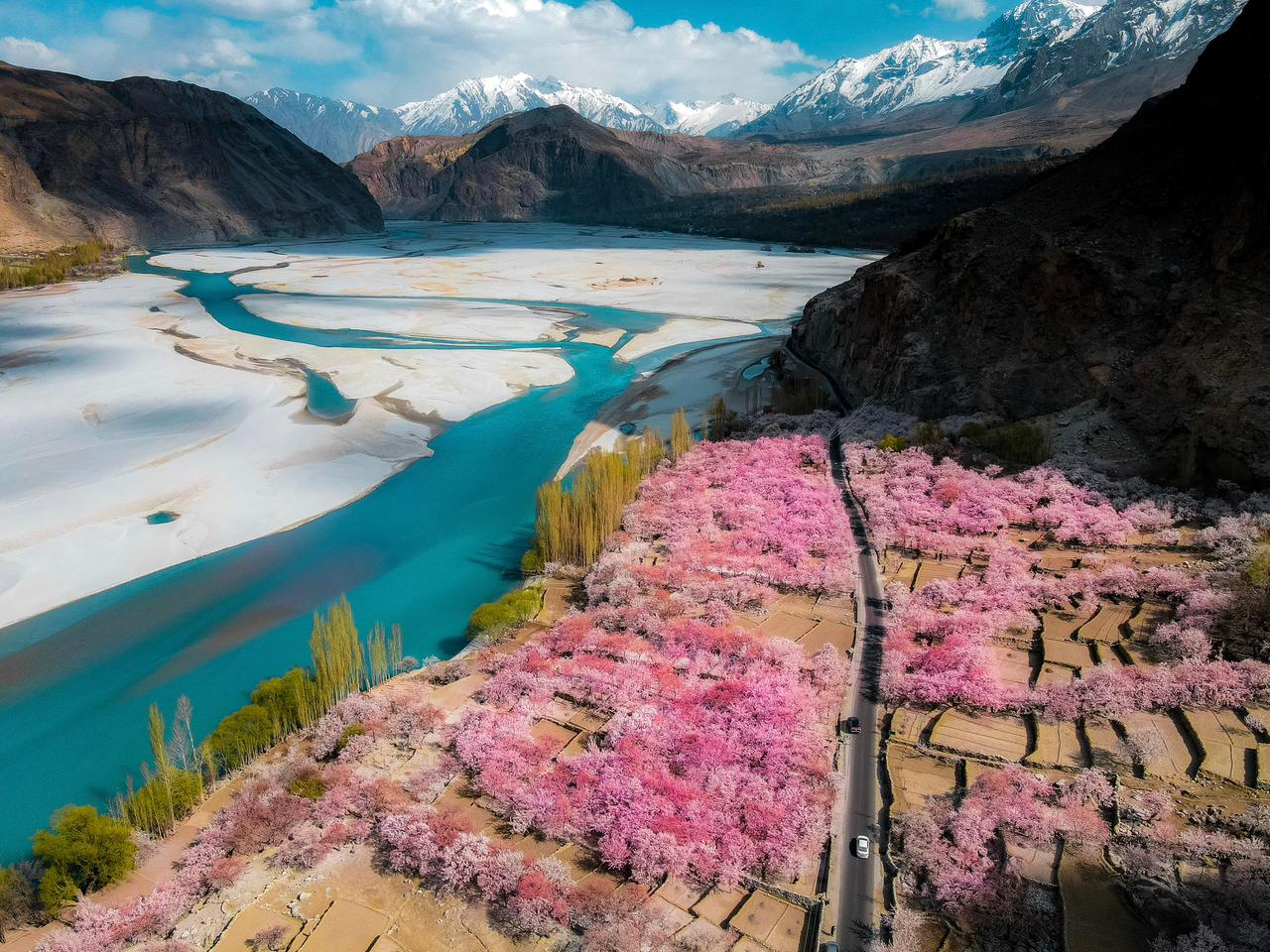
The road leaves Skardu heading north-east, crosses toward the Shigar river and then runs up a broad flat-bottomed valley between rock walls, with orchards and irrigation channels on either side and the river braiding across gravel beds below. It is a genuinely beautiful hour, and unlike Deosai it is beautiful the whole way rather than in one revelation at the end.
From Katpana we sit on the Skardu side of the confluence, so the drive does not start by crossing the bazaar. In July and August that saves a real amount of time, and in April it saves your temper. The same road carries every Baltoro expedition of the season: it continues past Dassu into the Braldu gorge, and if that is why you are here, the Skardu end of the K2 Base Camp trek is a separate business from a day out at the fort.
The Shigar road from Arcadian, Katpana
- Shigar town and the fort
- Roughly 30 to 35 km. Allow about an hour each way on metalled road; an ordinary car is fine.
- Blind Lake, on the way
- About thirty minutes from Skardu on the Shigar road, according to the Gilgit-Baltistan tourism department.
- Sarfaranga cold desert
- In Shigar district, near where the Shigar river meets the Indus. A short drive out from Skardu.
- Khaplu
- About 103 km east of Skardu, in the other direction. A separate day, not an extension of this one.
- Skardu International Airport
- Ten minutes by car from the hotel.
Our drivers run the Shigar road through most of the year and will tell you what the surface is doing this week.
Call 0310 097311903
Shigar and Khaplu are not one day trip
The single most common mistake in Skardu itineraries.
“They see two car parks and a lot of windscreen.”
Search for Shigar and you will find tour itineraries selling "Skardu, Shigar and Khaplu" as though the three sat in a line. They do not. Shigar is up a side valley running north from Skardu. Khaplu is about a hundred and three kilometres east of Skardu, up the Shyok. They are two different directions from the same town.
That means doing both in a day involves driving up the Shigar valley, coming back down it, passing Skardu again and then heading east for another hundred kilometres, before repeating the whole thing in reverse. We have watched guests attempt it. They see two car parks and a lot of windscreen.
We are also not going to give you a driving time for Skardu to Khaplu, because we cannot find one published anywhere reliable, and a wrong number on that road is the difference between arriving in daylight and arriving in the dark. The distance is well attested at around a hundred and three kilometres. The time depends on the surface, and the surface changes.
Khaplu Palace is worth its own day and its own write-up. It was built in 1840, restored by the same Aga Khan Trust for Culture, reopened in July 2011 as a twenty-one room residence, and it won the UNESCO Asia-Pacific Heritage Award of Distinction in 2013. The Chaqchan Mosque in Khaplu dates from 1370 by the Gilgit-Baltistan tourism department's own account, which makes it one of the oldest in the region. None of that is served by seeing it through a car window at four in the afternoon. We have now written it: our field guide to Khaplu Palace and the Shyok valley covers the hundred kilometres east, the Chaqchan mosque and why the trip wants an overnight.
If you only have one full day and you want a fort, take Shigar. If you have two, take them on separate days and put something low and slow in between.
04
What else is in the valley
Two old mosques, a lake, orchards, and sand.
The fort is the headline, but a day that consists only of the fort is a thin day. The valley has been inhabited and irrigated for a very long time and it shows.
The Amburiq Mosque is the one to see. Sources disagree on its age: the Aga Khan Development Network calls it fifteenth century, other accounts say fourteenth, and UNESCO's citation describes it as the first mosque built in Baltistan. Take the range rather than the tidy answer. It was restored by the Aga Khan Cultural Service and that work received a UNESCO Asia-Pacific Award of Merit in 2005. The Khilingrong Mosque, also in Shigar, is described by the trust as built four centuries ago and its restoration took an Award of Merit in 2012. Both are small, wooden, and much stranger than a photograph suggests.
Blind Lake, or Jarba Zhou, sits on the Skardu side of the run up to Shigar, about half an hour out of town by the tourism department's reckoning. It is a short stop rather than a destination, and it is best on a still morning when the reflection does the work.
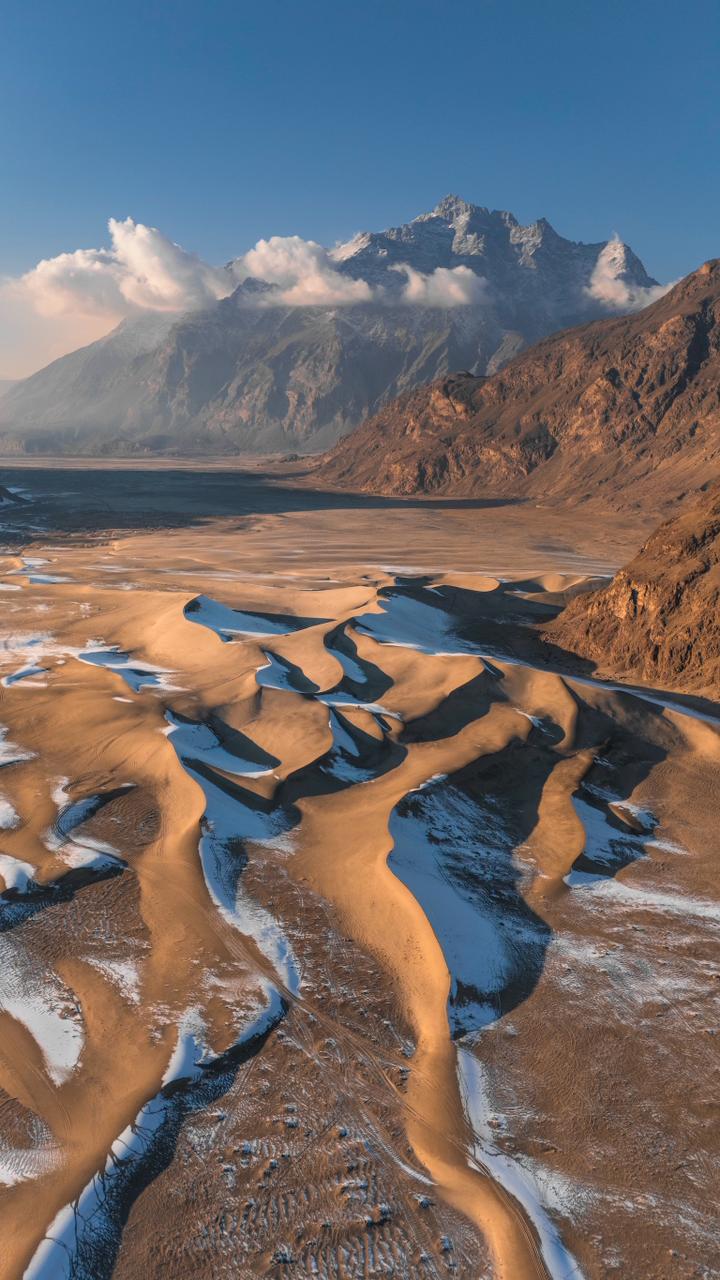
Then there is the sand. The Sarfaranga cold desert lies in Shigar district near where the Shigar river meets the Indus, out where the valley opens into the Skardu bowl. It is the larger sibling of the Katpana dunes we sit beside, and like Katpana it is worth nothing at midday and a great deal in the last hour of light.
The other thing Shigar has is apricots. The valley floor is orchard for much of its length, which makes April and early May, when the blossom is out, and then high summer, when the fruit is drying on every flat roof in the village, two completely different drives.
05
Shigar is the gateway to Askole, not the roadhead
Where the K2 trek actually starts, and how far past the fort it is.
A steady trickle of people arrive in Shigar believing they have reached the start of the K2 base camp trek. They have not. The trek starts at Askole, and Askole is a long way further up.
The route runs Skardu to Shigar, on up the Shigar valley to Dassu, and then into the Braldu valley to Askole. Metalled road gets you as far as Dassu. Past that it is jeep-only. The figures we have seen for Skardu to Askole cluster around a hundred and twenty kilometres and somewhere between five and seven hours, depending entirely on what the road has done recently. It is not a day trip and it is not something to attempt in a hired saloon.
What Shigar genuinely is, for trekkers, is the last comfortable place with a proper road before the track gets serious. Expeditions come through here. If you are heading for the Baltoro, your porters and your last hot shower are more likely to be arranged in Skardu and Shigar than anywhere above them.
Worth separating two things that get confused. Foreign nationals no longer need a No Objection Certificate to travel to Gilgit-Baltistan, including Shigar and Khaplu; the requirement was lifted in 2019 and we have found nothing reversing it. Trekking and mountaineering permits, and the fees for the Central Karakoram National Park and the Baltoro, are a completely separate regime and they still apply. Losing the NOC does not mean walking to K2 is now paperwork-free.
06
Season, and what it costs to get in
Year-round in principle, and no published entry rate in practice.
“Anyone telling you in advance what a Baltistan road will be like next month is guessing.”
Shigar is a year-round road in the way Deosai is not. There is no season when the plateau is shut and the valley is simply unreachable. What changes is the character: blossom in April, hard green in July, apricots on the roofs in August, gold and clear in October, and cold and very quiet from December.
That said, year-round is not the same as guaranteed. Gilgit-Baltistan took serious flood and glacial-lake damage in July 2026. The Jaglot to Skardu road, the main way in by land, was cut and reopened for all traffic on the twenty-seventh of July on a temporary steel bridge, according to the regional tourism department. Neither the Shigar road nor the Khaplu road was named among the closures, but the Hushe valley road beyond Khaplu was closed in late July, which matters if your plans run past Khaplu rather than stopping at it. Ask on the day. Anyone telling you in advance what a Baltistan road will be like next month is guessing.
As for money: there is no officially published entry fee for Shigar Fort or for Khaplu Palace. Not on Serena's site, not on the trust's, not from the tourism department. Day visits and museum access sit at the property's discretion, which in practice means it is a working hotel and you should call ahead rather than turn up with a coach party. Any rupee figure you have read on a blog is somebody's memory of a transaction, not a tariff.
Carry cash in rupees, dress for a mosque if you intend to visit one, and do not assume a card will work anywhere between Skardu and the fort.
07
Where Shigar fits in a Skardu week
A good day two, for a reason people get wrong.
Shigar sits at roughly the same height as Skardu, somewhere around two thousand two hundred metres, give or take. Published elevations for the town are hard to source properly, so treat that as approximate. What matters is the shape of the day rather than the number: you drive an hour on the flat, you walk around a building and a garden, and you come home to sleep at the height you woke up at. There is almost no altitude gain in it.
That makes Shigar an excellent second day. Day one in Skardu should be arrival and very little else. Day two wants something that fills the time without climbing, and Shigar and the two Kachura lakes are the two obvious candidates. Deosai, which gains something like eighteen hundred metres before lunch, belongs on day three or later.
The pairing we suggest most often is Shigar in the morning and the dunes in the late afternoon, either Sarfaranga on the way back or the Katpana dunes on our doorstep. Fort, orchards, then sand at last light. It uses the middle of the day, which is the flattest and least photogenic part of a Baltistan afternoon, on the drive.
Arcadian Hotel and Resort sits at Katpana, ten minutes from Skardu International Airport, with sixteen rooms in two types, a garden, a pool through the warm months and breakfast from six for people who want the valley to themselves. We will arrange the car, and we will tell you honestly if the fort is worth it in the weather you have got.
Sixteen rooms, a driver who ran the Shigar road this week, and breakfast from six.
See the rooms and ratesGuest feedback
What guests actually say
We don't publish a star score of our own, because the only ratings worth reading are the ones we can't edit. Reviews for Arcadian Resort Skardu live on the booking platforms below, written by guests who paid for their rooms. Read them there, including the critical ones.
Location
Where Arcadian Resort actually is
Arcadian Hotel & ResortKatpana Road, Katpana, Skardu 15100
Gilgit-Baltistan, Pakistan 15100
0310 0973119
Arcadian Resort sits in Katpana, on the quiet side of Skardu: roughly ten minutes from Skardu Airport, ten minutes from the Katpana cold desert dunes, and fifteen to twenty minutes from the bazaar and Kharpocho Fort.
How we know this
We run a sixteen-room hotel in Katpana, on the Skardu side of the Shigar confluence, and our drivers run the Shigar road through most of the year. Drive times, road surfaces and what the valley is like in a given month come from them and from guests reporting back the same day. The history of the fort, the restoration, the UNESCO awards and the mosque dates are taken from the published sources listed below rather than from other travel sites. Where a figure is not officially published, most importantly any entry charge at Shigar Fort or Khaplu Palace, we say that plainly instead of repeating a number from a blog. Where our sources disagree, as they do on the age of the Amburiq Mosque, we give the range rather than picking the tidier answer.
Reviewed: Each season, and after any flood or road event on the Shigar and Indus roads.
Written and checked by the team that runs the house in Katpana, Skardu — the people who watch the Deosai road open and close, book the drivers, and answer the phone at midnight. Our editorial standards.
Sources
Where the figures come from
- Aga Khan Development Network — conservation in Gilgit-Baltistan ↗
- Source for the restoration of Shigar Fort and Khaplu Palace, and for the 1840 date and 2011 reopening at Khaplu.
- UNESCO Asia-Pacific Heritage Awards, 2006 winners ↗
- Confirms Shigar Fort received the Award of Excellence in 2006. It is an award, not World Heritage status.
- Gilgit-Baltistan tourism department — District Shigar ↗
- Regional tourism authority for Shigar district, Blind Lake and the valley's attractions.
Questions
Practical questions about Shigar Fort and the valley
Roughly thirty to thirty-five kilometres north of Skardu town, and about forty-five minutes to an hour by car. Serena, which operates the fort, describes its property as an hour's drive from Skardu. The road is metalled effectively the whole way and an ordinary car is fine, so unlike Deosai you do not need a 4x4 for this one. You will occasionally see half an hour quoted; we have not managed it in that.
Rooms & prices →Go early, and give it the whole morning
Shigar rewards a slow visit. The fort is an hour if you walk it briskly and half a morning if you actually look at the woodwork, and the valley around it is the part most day-trippers drive past on the way to a car park. Leave after breakfast, stop at Blind Lake if the water is still, look at one of the old mosques, and be back in Skardu with the afternoon intact.
Arcadian Hotel and Resort sits at Katpana, ten minutes from Skardu International Airport and on the right side of town for the Shigar road. Breakfast runs from six. To check availability, ask what the road is doing this week, or arrange a driver, call or WhatsApp the front desk on 0310 0973119.
Keep reading